

The Vision Behind La Grande Mare's Transformation
European Golf Design architect Robin Hiseman has worked on proposed Ryder Cup venues and championship layouts around the world. Now he has brought that experience to La Grande Mare, designing a contemporary course intended to challenge skilled players while remaining enjoyable for golfers of all abilities.
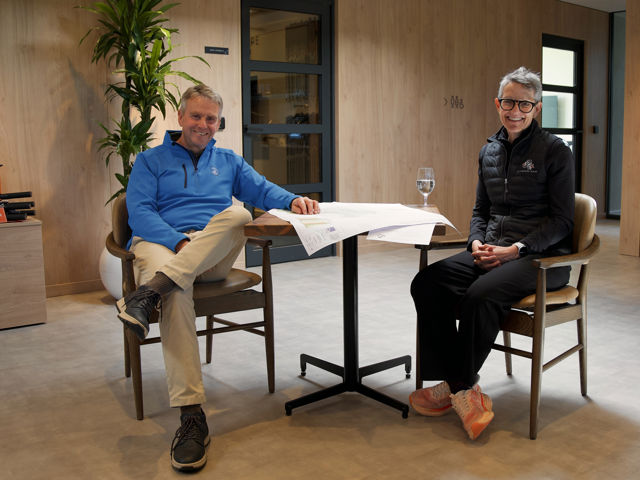
Robin spoke to Sue Shapcott, Golf Performance Director, about the art of golf course design, the inspiration behind La Grande Mare’s renovation, and what makes the course so unique.
SS: Robin, very nice to see you. I had a nice walk around the golf course yesterday, and whenever I meet golf course architects, I’m always interested to know whether a new design is ever inspired by other courses.
RH: We all carry around a huge portfolio of ideas in our heads, and you try not to be too literal with the inspiration you draw from. There is one hole here that I would say is a fairly literal representation of another hole, but I am not going to tell you which it is – you might know anyway! But, yes, there was one course that inspired the look of the new La Grande Mare, and that was Seminole in Florida. I've not actually been there, but I've studied it, and the reason for that was that it is also a small, compact piece of flat ground. It's also crisscrossed by very geometric canals and waterways, which is what we had here.
It's also in the world's top thirty golf courses, so I thought that's not a bad place to start. We can draw some inspiration from that and maybe do a scaled-down version of Seminole - and that's what I suggested to Steve Lansdown back in 2019.
So, that inspiration led to the narrative for styling parts of the golf course, particularly in and around the clubhouse. Again, it’s not a literal copy, more of a thematic one. Then, here and there around the place, the first green, for example, is a version of the first green at Royal Dornoch, with a low pocket in the back corner. I thought it would be quite nice to lead players softly into the second tee. All the way around the golf course, you kind of pick up these little bits of inspiration.
SS: European Golf Design has designed lots of very good golf courses. Which are your more famous courses that people might know?
RH: We've certainly done a lot, and we do have quite a few famous courses. I think the ones people will know are primarily those that have hosted the Ryder Cup. For example, my colleague Dave Sampson completely rebuilt Marco Simone and Ross McMurray designed the 2010 Ryder Cup course at Celtic Manor, and redesigned Le Golf National in Paris for 2018. My design at the JCB Golf & Country Club hosts the LIV UK tournament and the Royal Golf Club, in Bahrain currently hosts the Bahrain Championship on the DP World Tour. In Dubai, Dubai Hills was voted the world's best new course when it opened, and European Golf Design is the design company of the European Tour, so we do get involved in many tournament and resort courses around the world. I think Marco Simone’s recent hosting of the Ryder Cup has been the course of ours with the most global exposure.
SS: Were you out there for the Ryder Cup?
RH: Yes, we were there all three days.
SS: Do you have much input on the course setup or pin placements?
RH: Yes, we do. There were discussions with the Ryder Cup captain, Luke Donald, who would come out and talk to Dave about how he wanted the fairway lines to be cut, because they have control over that.
We were certainly heavily involved in where all the grandstands would go, service areas and hospitality suites. The course was planned with that in mind.
SS: I assume each course is very bespoke; what are the unique characteristics of the course here at La Grande Mare?
RH: I've racked my brains to think of another course that combines what we've got here, which is a modest-length golf course - but built to a very high tournament specification. We brought in the agronomists who consult to Adare Manor for the Ryder Cup, and the greens here and the surrounds here are built to exactly the same specification as Adare Manor. The conditions we will have here are what they'll be playing on during the Ryder Cup next year. And then, on top of that, the design is built to a very intricate testing standard.
Whilst there are a few eighteen-hole courses within the British Isles that are short and very well regarded, such as Formby Ladies and Sunningdale Heath, there is nothing like this, which is contemporary and built to a modern specification. I can't think of a single course that looks anything like this.
SS: With new technology, players are obviously hitting the ball further than ever. How do you balance trying to make holes difficult and challenging, but also make them enjoyable for everyone to play?
RH: I think we've got to show some realisation of the fact that the guys who can carry the ball three hundred yards through the air are going to look at this course in a very different way than someone who hits it one hundred and thirty. Their target areas will be very different. We've got six drivable par fours, but the way we defended against that is by making the course very technical. There are many holes that you probably would not advise taking your driver on. Four is a good example of that, where you might try it and get into trouble. You can easily get into difficulty here if you are wild, so I think the longer golfers are going to have to temper their aggressive tendencies just to keep it out of the ditches, ponds and hedgerows.
I think for the handicap golfer, it's much more accessible because space is provided where they generally hit the ball. On most holes, there's a bailout on one side or the other. Some are more generous than others, and sometimes we close it in and say, ‘The test on this hole is to hit it straight.’ Number seventeen is a great example of that. So, tee positioning is very important. We’ve provided a good range of tees, so I would always advise people to make sure they're on the right set of tees for their ability.
I think if they do that, you can manoeuvre your way around here. Even high handicap golfers are going to be close enough to the greens after the tee shot to think they can get the odd birdie and a good crop of pars. I think it's going to be very playable for them.
SS: Some courses seem set up to be more punitive for slices or hookers. Is that the case here? Is there more trouble on the right or left?
RH: Overall, I would hope it's balanced.
Generally speaking, there are crosswinds on this golf course given its orientation, but no, I don’t think it favours one shot shape ahead of another. You'll see that as you go out there, with holes that bend sharply to the left and to the right. I think there's a fairly decent balance.
SS: Which is your favourite hole out there?
RH: I am very fond of a few of them. I think the first hole, particularly, which is the old eighth hole here, which people might remember, is a very strategic start to this golf course. It sets the agenda and pattern of play. You can see everything in front of you – you can see the green, and you can see that the line to the green is very well defended. You can also see that, to the left, there is all the room in the world if you are not ready. If you're not warmed up and just aim it left, you've got space. But then the angle into the green is poor. And the further left you go, the worse it gets. So that risk and reward and strategic diagonal lines is set up immediately from the first hole. We carry that theme all the way through.
However, the hole I think I'm maybe most fond of is the third because it's one of our two brand new holes, so there was an opportunity to create something from scratch. I am very fond of the alignment of that hole and the lovely green setting up by the boundary wall. And the way that green sort of folds into the fourth tee. There is a very nice little optical illusion on that hole in the way we've designed the fairway bunkers. It was one of the first holes we built, and I was very particular with how we built those fairway bunkers. However, I am going to give away a secret: you stand on the tee, and the bunkers look like they're at the green, but they're not. In fact, they’re a long way short of it, so you've got this hidden valley behind them and a type of visual deception that I like very much.
SS: When golfers play here at La Grande Mare, how do you want them to feel? What would be satisfying for you?
RH: I want them to be excited! I want them to go to that first tee eagerly anticipating what they're going to tackle. I want them to be optimistic about how the game is going to unfold. Personally, I don't want to go out onto a golf course and just feel dread from the first tee and that it’s going to be a slog.
I don't think people are going to feel that here because they know they're going to get birdie chances, and that just makes people feel happy on the tee. I think excitement, optimism, but maybe most of all, mentally engaged with what's in front of them.
I think once they get here, they're going to regard this as a memorable golf course. Hopefully, they'll really get into the design of it quite quickly - that's what I want.
SS: So, do players have to think their way around the golf course?
RH: Yes, and as an architect, that's what we want people to do. I think we've succeeded in our job if people have to engage their head as well as their technique as they're going around and they come off the course remembering it.
I’m quite confident that we've got eighteen holes out there that are all very individual and will stick in the memory.