

Mind Over Matter: Unlocking Your Best Golf with Karl Morris
The difference between a good golfer and a great one isn’t always found in the swing. Often, it’s how they take their practice game to the golf course that determines how well a player performs when it matters.
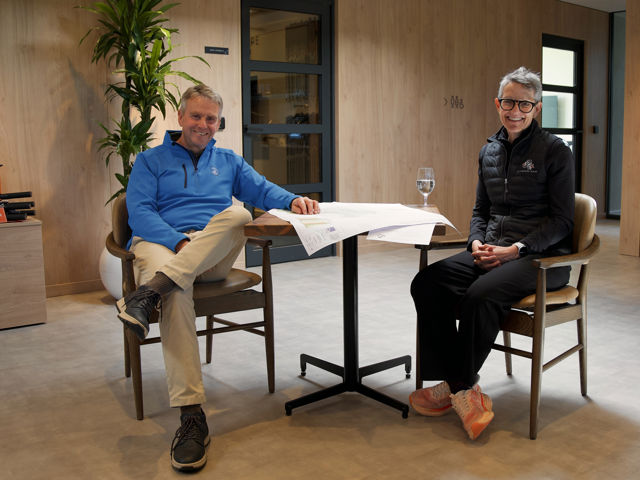
During a recent visit to La Grande Mare, leading performance coach Karl Morris sat down with Golf Performance Director Sue Shapcott to discuss how golfers of every ability can perform more effectively on the course.
SS: Karl, you've worked with some of the very best golfers in the world, as well as thousands of everyday players, regardless of ability. What are the most common mental barriers you see that prevent players from playing to their potential?
KM: I think the biggest issue, Sue, is that we practice golf in a unique environment, like a beautiful range that we've got here, which is a great place to learn movement and develop skills. But then, we try to transfer those skills out onto the golf course, which is a completely different dynamic. So, I have two key principles to get good at golf. Number one, you've got to develop skills; for example, you've got to be able to control and hit the centre of the clubface. But then, you've got to know how to be able to access those skills on the golf course, and that requires a different focus.
SS: I agree. You've worked with Ryan Fox for several years and recently saw him become the 2026 Open champion. What did you see in Ryan's mindset at Birkdale that enabled him to perform so successfully under that level of pressure? And what can the everyday golfer learn from it.
KM: There are two ways you can play golf. You can play in pursuit of good shots, or you can fall into the trap of avoiding poor shots – essentially, you're either in a pursuit mindset or an avoidance mindset.
That week with Ryan, we talked a lot about the golf course. For seven years, a huge talking point for us has been that he's at his best when he's really absorbed in Ryan Fox against the golf course, not against anybody else. Everyone else becomes irrelevant and that week, certainly from Friday onwards, it was very much about the pursuit of good shots as opposed to avoiding poor shots.
That doesn't mean being reckless, and the final round summed that up, when Ryan got to the 18th tee and tied for the lead. It was an incredibly difficult tee shot, and he discussed it with his caddie. They decided to pursue and try to make three instead of settling, hoping to make four and maybe getting into a playoff. So that’s the perfect example – he was in pursuit of a good shot down the final hole, as opposed to avoiding mistakes. He was willing to accept the consequences of that decision, and it was an agreement we talked about all week.
SS: I see, so you're making a conscious decision to play a certain way so, even if it doesn't come off, you’re okay with it, because it was your choice?
KM: Absolutely. He chose to take that tee shot even if it ended up in the bunker or the rough and was going to be able to live with that because he had a clear intention of what he was trying to do.
From time to time, we all fall into the trap of getting a bit defensive with golf. We try to avoid certain patterns, hooks, slices, or whatever and fall into the avoidance trap. There's a different set of chemicals going through your system, as opposed to when you're in pursuit of good shots.
However, the ironic thing is that what holds everything together in pursuit golf is a willingness to accept all outcomes. You can't play pursuit golf if you hit some bad shots and can't deal with it. You can only play it when you're willing to accept that there will be some setbacks and there'll be some dropped shots and some out of bounds and things like that. It’s a state of understanding.
SS: Thinking about players pursuing or avoiding something; does that apply to you too? When you're working with someone, are you making a conscious decision about the strategies you give them?
KM: Yes, and I think there are a couple of key questions for everyone. One of the biggest that we don't ask enough is, why do I play golf? It sounds easy, but I always tell people not to take the first answer that pops into your brain; really dig deeper.
What is it that really floats your boat when you're out there? Because when you delve into it, some important things come up. One of the biggest things is that, once you understand why you play golf, it’s important to think about why you play golf when you play.
For instance, some people say they love the social side of golf. They'll then three-putt the third in the medal on a Saturday and won’t speak for two hours. That's not honouring your commitment, but it’s different for everyone.
You need to understand what it is about the game that really resonates at a deep level and makes you want to invest your time, energy and effort.
SS: One of the central ideas within your coaching is intention, attention, attitude. Can you explain those three elements and how golfers can apply them to their own game?
KM: I think those are the three words that hold the mental game together. You can look at them on an individual shot or in a tournament. In fact, you can look apply them to your whole life, but let’s keep it simple and look at an individual shot.
So, intention starts with having real clarity; what do I intend this golf ball to do? Do I want it to start on this line and draw or fade, go high or low? It sounds an obvious thing to say, but so many golfers are obsessed with the swing.
It's like a sat nav; unless you put the postcode into it, it doesn't know where it's trying to take you. Having a clear intention of what you want the golf ball to do allows you to focus your attention.
Then there’s intention: What do I want the golf ball to do? What do I need to feel? That's attention, and then I’ve also alluded to attitude as a willingness to accept outcomes. I think acceptance is the glue that holds it all together; it’s about dealing with the reality of golf as a tough game - even the best players in the world hit it sideways. It’s about having a willingness to deal with the variety of outcomes that golf will always give.
SS: You're right, it's very similar to life.
KM: Golf is life in the sense, it's fundamentally chaotic. How many times do you get a top player shooting 64 and following it with another 64? It hardly ever happens.
I have a lovely guy I've worked with for a long time, who’s a very, very good player. He was playing on the Challenge Tour last year, the first round in a tournament on the oldest course in South Africa and had a bad day. He ended up shooting 80 in the first round but didn’t feel as if he’s played that badly. The next round, he shot 60 but didn’t feel like he’d played that well. It just shows the variety of outcomes that we can get in the game and how it makes us feel.
SS: Yeah, agreed. You've spoken about golfers practising brilliantly on the range but struggling to transfer that performance onto the course. How can we make practice more representative of the demands we face when we're actually playing?
KM: Fundamentally, when you're on the golf course, it’s one shot, one unique location, and there's a score involved, so I think practice should focus on those three elements. a big fan of things like dividing your practice up into 10 balls where you may be 10 shots to 10 different targets with 10 different clubs and you grade each shot one, two or three; one would be a good shot, two would be good enough, and three would be a poor shot, so every single shot, there’s a different club, different target.
Now, we've got a score involved, and when you're doing things like that, you're allocating a certain number of balls with a specific purpose to different targets and starting to replicate golf a little more. I think we see golf courses as a proving ground, not a training ground, but there are several games you can play on the golf course that make training interesting.
SS: I'm always amazed when I go and watch a golf tournament now. Yes, the best players are great ball strikers, but it stuns me how they eliminate double bogeys and triple bogeys. I mean, they figure out how to get the ball around.
KM: Yes, you’re absolutely right and a lot of the time when you apply it to amateur golfers, somebody wants to get from, say, 15 to single figures. Statistically, we know they've got to reduce the doubles and triples, not make more pars. Everybody thinks it's about more birdies than pars.
They're nice when they come along, especially birdies, but it's about reducing doubles and triples. I think that most amateur golfers, when they miss a green, are asking the wrong question. They start thinking about how they can make par, start taking on difficult shots, and maybe leave it in a bunker. If the question was, “How can I make bogey?” Suddenly that's different, and you played into the wide part of the green.
You play a simple chip and run with it with a rescue club or something like that. Now, you might not make par; you’re pretty much guaranteed a bogey. But you will make some pars because you're all the 15-footer or a 20-footer every now and again, but you're reducing the doubles and triples.
SS: Pressure affects every golfer. What happens to our decision-making under pressure, and what can we do to stay committed to the shot in front of us.
I think the whole thing with pressure is that it activates the threat response in our brain, and with a threat response, we either fight it, we run away, or we or we freeze. So, before you even play, I think it comes back to acceptance again.
What's the worst that could happen today? You could shoot 90. You could shoot whatever your standard is. Put that out on the table before you start and resolve that you'll deal with it. If you know you'll deal with it, even if it comes along, and that massively reduces the pressure because the elephant's out of the room.
Most people play golf subconsciously, resisting the fact that it could be a bad day. When you bring it out into the open and accept that it could happen, this great paradox kicks in. When you're not resisting bad scores, and you're willing to deal with them, you reduce the likelihood of it happening.
SS: At La Grande Mare, we're very focused on helping golfers understand their own game, rather than prescribing a single way to play. How important is self-awareness for becoming a better golfer?
KM: It’s the single most important thing. For whatever reason, I idolised Bruce Lee when I was younger and at the end of his life, he was a great scholar.
He was a great, very learned man, and he wrote down four tenets to get better at anything, whether martial arts, business, or golf. The number one thing that he said was that you need to research your own experience, and I don't think golfers do that. We want everybody to tell us what to do all the time, rather than learn from our own experiences.
Now, after 30 years of doing this, golf's a study of one. It's nice to know what Scottie does and what Tiger did and what Jack said and Ben and all the rest of it, but, ultimately, it's about you finding out about yourself and what makes you tick - understanding yourself and your own tendencies.
SS: If there was one change, you would encourage every amateur golfer to make to their mental game. What would it be?
KM: To develop a thorough understanding and appreciation and be willing to work on acceptance. And acceptance isn't giving up. Acceptance isn't being happy with bad shots; acceptance is being willing to deal with the reality of the game. When you can do that, you're then free to explore your capabilities.
For more information about Karl Morris including his book, The Mind Caddie, visit www.themindfactor.net